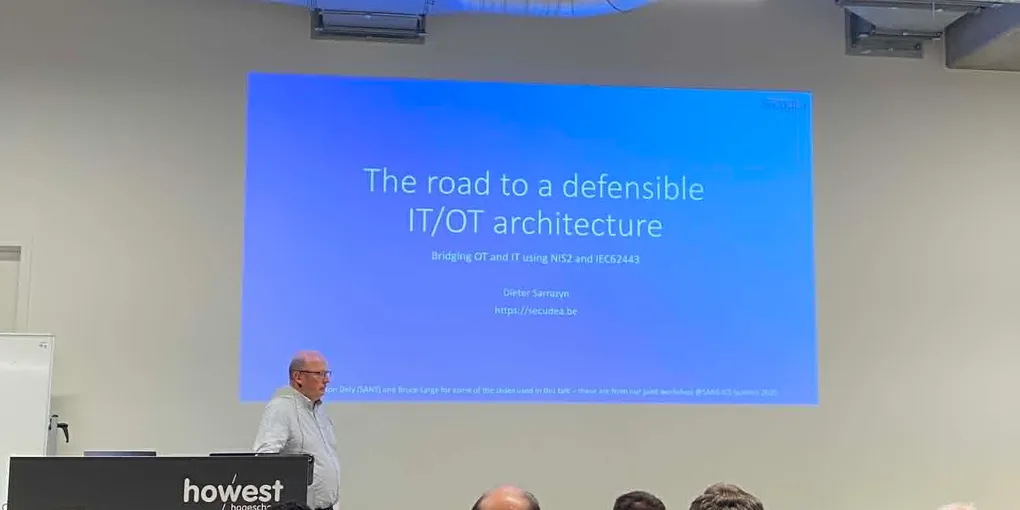
T&M1: The road to a defensible architecture
On October 1st, I attended my first Tech&Meet event of the new school year. The session, presented by Dieter Sarrazyn, focused on the differences between IT and OT environments and how organizations can bridge the security gap between the two using frameworks such as NIS2 and IEC62443.
Dieter started the presentation with a short introduction to Operational Technology (OT) environments and how they differ from traditional IT systems. Unlike standard IT environments, OT systems often control industrial processes and critical infrastructure, making availability and operational continuity extremely important. He also discussed how malware such as NotPetya managed to impact poorly secured environments, immediately showing why strong architecture and segmentation are essential in industrial settings.
After the introduction, Dieter explained what makes a good “defensible architecture.” The main goal of such an architecture is to reduce risk as much as possible through careful system design, segmentation, and secure implementation. Instead of relying on one large security boundary, modern OT environments should be divided into smaller segments with different trust and security levels.
A large part of the session focused on the IEC62443 framework and how it can be used to structure security in industrial environments. Dieter explained the different security levels within the framework and demonstrated how a monolithic security approach can evolve into a segmented architecture where systems are separated based on risk and functionality. This made the concept much more practical and easier to understand.
The presentation also covered the defensible architecture lifecycle. The process starts with the scoping phase, where organizations gather as much information and context as possible about their environment. After that comes the design phase, where a secure architecture is planned based on the collected information. Next is the implementation phase, where systems are deployed according to the design, followed by the maintain phase, where the environment is continuously monitored, assessed, audited, and tested to ensure long-term security and resilience.
Towards the end of the session, Dieter briefly discussed OT security governance and linked it to standards such as the ISO27000 family and the NIS2 directive. This part highlighted how regulations and standards are becoming increasingly important for industrial organizations, especially now that cyber threats against critical infrastructure continue to grow.
Overall, I found the session very interesting because OT security is quite different from the more traditional IT security topics I am used to. The presentation gave a clear overview of how industrial environments approach cybersecurity and how a framework such as IEC62443 and can help organizations build more resilient and defensible systems. It was a technical but accessible session that gave me a better understanding of the challenges surrounding modern industrial cybersecurity.